
By Laura Schemitsch, Canadian Immigration and Refugee Lawyer
作者:Laura Schemitsch,加拿大移民与难民律师
Heron Law Offices 近期协助两位客户,就其通过加拿大快速通道(Express Entry)系统下的加拿大经验类(Canadian Experience Class,“CEC-EE”)提交的永久居民电子申请(“e-APR”)被拒一事,在加拿大联邦法院提出许可及司法复核申请后成功达成和解。
The First Case
In the first case, a former client approached us in early 2025 to assist following the rejection of their self-represented e-APR as a member of the CEC-EE. In the refusal letter, the Officer found that the Applicant no longer met the requirements for two (2) years of skilled Canadian work experience, which resulted in a loss of points. As such, the officer argued the Applicant had not maintained the minimum Comprehensive Ranking System (“CRS”) score to apply. In the Rule 9 Reasons, obtained through the judicial review process, the Officer found that the Applicant no longer met the minimum eligibility criteria to apply.
We argued the Officer’s differing conclusions lacked coherence and intelligibility as required by the Court in Vavilov.
We also argued the Officer erroneously determined that two specific periods of skilled Canadian work experience the Applicant included after applying but before receiving their Post-Graduate Work Permit (“PGWP”) while on maintained status did not count towards their qualifying Canadian work experience. CEC-EE requires a minimum of one year of Canadian skilled work experience, but the Applicant received CRS points for two years. We further argued that the Officer failed to properly apply Immigration, Refugee and Citizenship Canada (“IRCC”)’s Program Delivery Instructions (“PDIs”) for assessing eAPRs and qualifying work experience under CEC-EE and the Ministerial Instructions in place for the Applicant’s round of Invitations.
Results
The Applicant received a settlement offer in the fall of 2025 and recently received landing instructions for permanent residence. The Applicant also submitted a reconsideration request, but did not receive a response.
The Second Case
In the second case, our client’s self-represented e-APR was refused in early 2025 on the basis that the Applicant had not provided “sufficient proof of employment in Canada after PR” to continue to be awarded points for Arranged Employment and, therefore, to no longer possess the qualification based on which they were ranked for CEC-EE. It is worth noting that as of March 25, 2025, additional points are no longer awarded for Arranged Employment. In this case, the Applicant had a valid job offer and was correctly awarded points for Arranged Employment (prior to this year’s change). In our client’s case, they changed employers following the submission of their e-APR for a temporary position outside Canada. The Applicant provided proof of their intention to return to Canada upon landing as a PR.
The Officer did not explain why the evidence provided was not sufficient, and we argued that they further erred by creating this unreasonable requirement.
We also argued the Officer failed to properly assess the PDIs for CEC-EE e-APRs and erred by deducting the Applicant’s properly awarded points for Arranged Employment.
Results
The Applicant received a settlement offer one month following submission of the Applicant’s Record and re-opening instructions in the fall of 2025. Our client also recently received landing instructions.
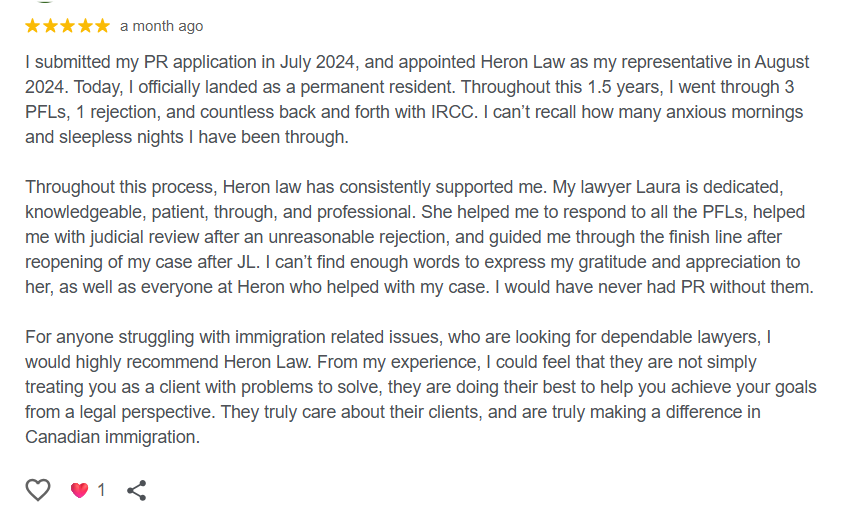
更新于2026年3月24日:上述两起案件中的一位客户已在Google上为本案留下了积极的评价。感谢您!
For more information about how HLO can you following an immigration application refusal, please contact info@heronlaw.ca for a consultation.