

By Laura Schemitsch, Canadian Immigration and Refugee Lawyer
Heron Law Offices recently helped two clients obtain settlements following their applications for leave and judicial review in the Federal Court of Canada, regarding their refused electronic applications for permanent residence (“e-APR”) via the Canadian Experience Class (“CEC-EE”) under Canada’s Express Entry system.
The First Case
In the first case, a former client approached us in early 2025 to assist following the rejection of their self-represented e-APR as a member of the CEC-EE. In the refusal letter, the Officer found that the Applicant no longer met the requirements for two (2) years of skilled Canadian work experience, which resulted in a loss of points. As such, the officer argued the Applicant had not maintained the minimum Comprehensive Ranking System (“CRS”) score to apply. In the Rule 9 Reasons, obtained through the judicial review process, the Officer found that the Applicant no longer met the minimum eligibility criteria to apply.
We argued the Officer’s differing conclusions lacked coherence and intelligibility as required by the Court in Vavilov.
We also argued the Officer erroneously determined that two specific periods of skilled Canadian work experience the Applicant included after applying but before receiving their Post-Graduate Work Permit (“PGWP”) while on maintained status did not count towards their qualifying Canadian work experience. CEC-EE requires a minimum of one year of Canadian skilled work experience, but the Applicant received CRS points for two years. We further argued that the Officer failed to properly apply Immigration, Refugee and Citizenship Canada (“IRCC”)’s Program Delivery Instructions (“PDIs”) for assessing eAPRs and qualifying work experience under CEC-EE and the Ministerial Instructions in place for the Applicant’s round of Invitations.
Results
The Applicant received a settlement offer in the fall of 2025 and recently received landing instructions for permanent residence. The Applicant also submitted a reconsideration request, but did not receive a response.
The Second Case
In the second case, our client’s self-represented e-APR was refused in early 2025 on the basis that the Applicant had not provided “sufficient proof of employment in Canada after PR” to continue to be awarded points for Arranged Employment and, therefore, to no longer possess the qualification based on which they were ranked for CEC-EE. It is worth noting that as of March 25, 2025, additional points are no longer awarded for Arranged Employment. In this case, the Applicant had a valid job offer and was correctly awarded points for Arranged Employment (prior to this year’s change). In our client’s case, they changed employers following the submission of their e-APR for a temporary position outside Canada. The Applicant provided proof of their intention to return to Canada upon landing as a PR.
The Officer did not explain why the evidence provided was not sufficient, and we argued that they further erred by creating this unreasonable requirement.
We also argued the Officer failed to properly assess the PDIs for CEC-EE e-APRs and erred by deducting the Applicant’s properly awarded points for Arranged Employment.
Results
The Applicant received a settlement offer one month following submission of the Applicant’s Record and re-opening instructions in the fall of 2025. Our client also recently received landing instructions.
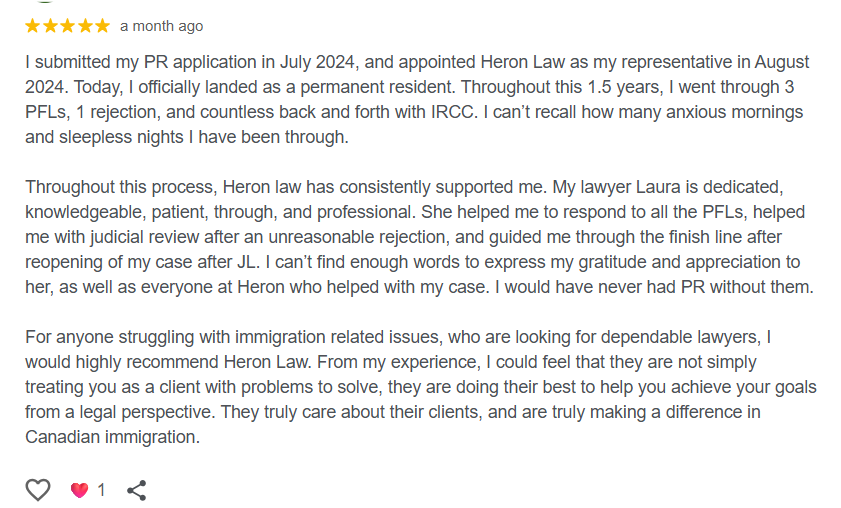
Updated on 24 March, 2026: one of the clients from the above two cases has kindly left a positive Google review about this case. Thank you, dear Client!
For more information about how HLO can you following an immigration application refusal, please contact info@heronlaw.ca for a consultation.