
This year, UBC’s Peter A. Allard School of Law awarded the Tao Award in Law for the first time. I’m grateful to introduce its first recipient, Julia Kwasniak, a third-year J.D. student.
Why I Established This Award
I created this award in memory of my father, Jing-Song Tao. He came to Canada from China and completed his Ph.D. at UBC in 1998. His immigrant journey shaped my life, and in many ways, it shaped the path I eventually took in my career. He passed away in 2016, and I often think about how much of the work I do today traces back to him.
I also know I didn’t get here on my own. Along the way, I was supported by mentors, supervisors, classmates and a broader community, many of them connected to Allard, who made room for me while I was still figuring out what kind of lawyer I wanted to be. Third year of law school can come with real pressures, financial and otherwise. My hope was that this award could ease a little of that for a student who wants to serve migrant communities, and perhaps signal to them that there are people in this field who are glad they’re here.
It’s a small gesture. But it’s one way of passing forward some of what was given to me.
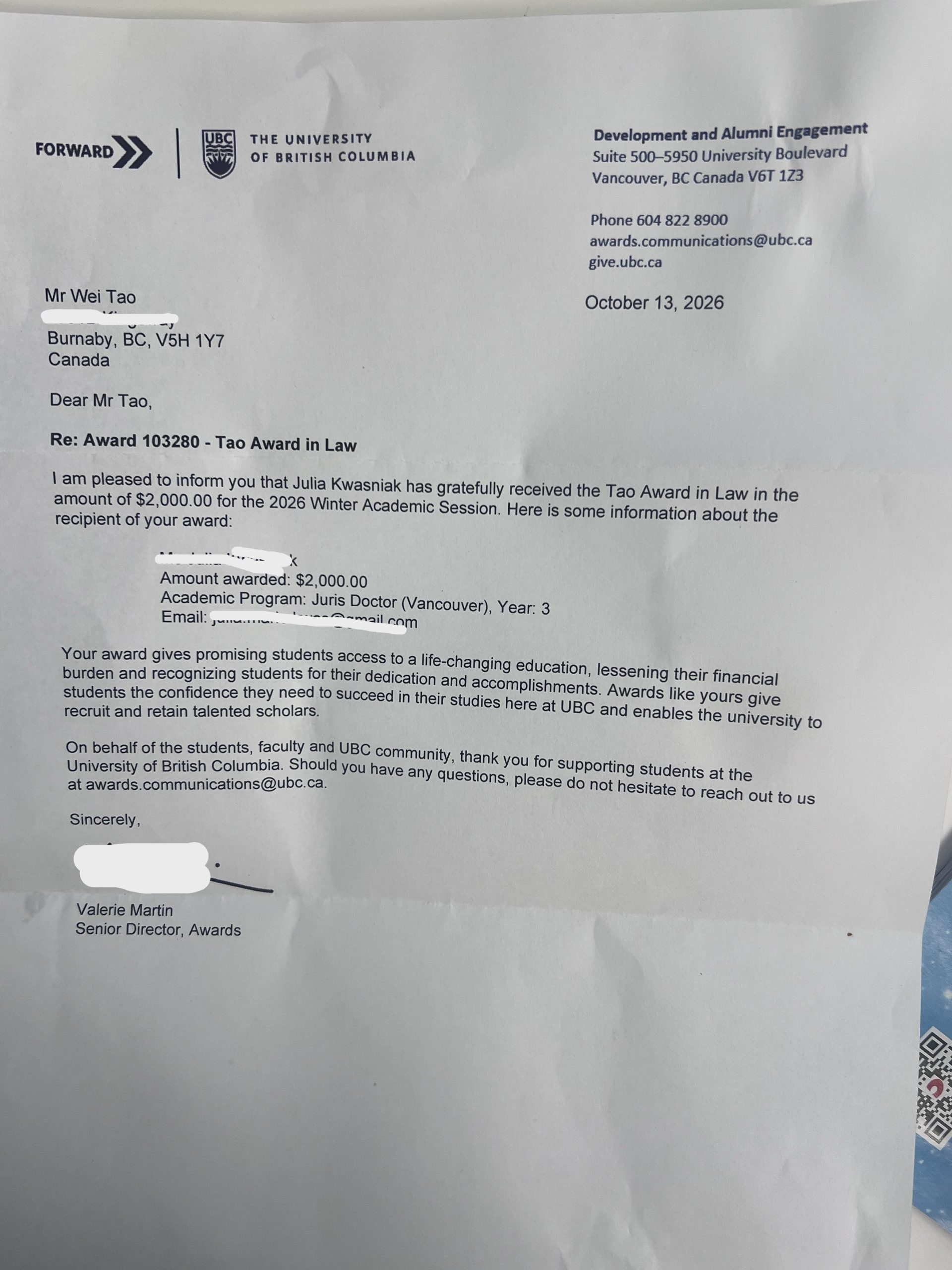
Letter received from UBC Allard law school.
Julia is currently on exchange in Hong Kong. She kindly agreed to answer a few questions about how she came to this area of law, what she has been learning, and where she sees room for change in Canada’s immigration and administrative justice systems.
Q&A with Julia Kwasniak
Tell us your story of getting into immigration/admin law
My path into immigration law unfolded rather organically.
My mother and father immigrated to Canada from Japan and Poland, respectively, in the 90s. Arriving alone in a foreign country, on an entirely different continent no less, and speaking little English was not for the faint of heart. My father later sponsored my Polish grandmother, who helped raise me while my parents worked. Immigration and the immigrant experience were, in many ways, part of the family DNA.
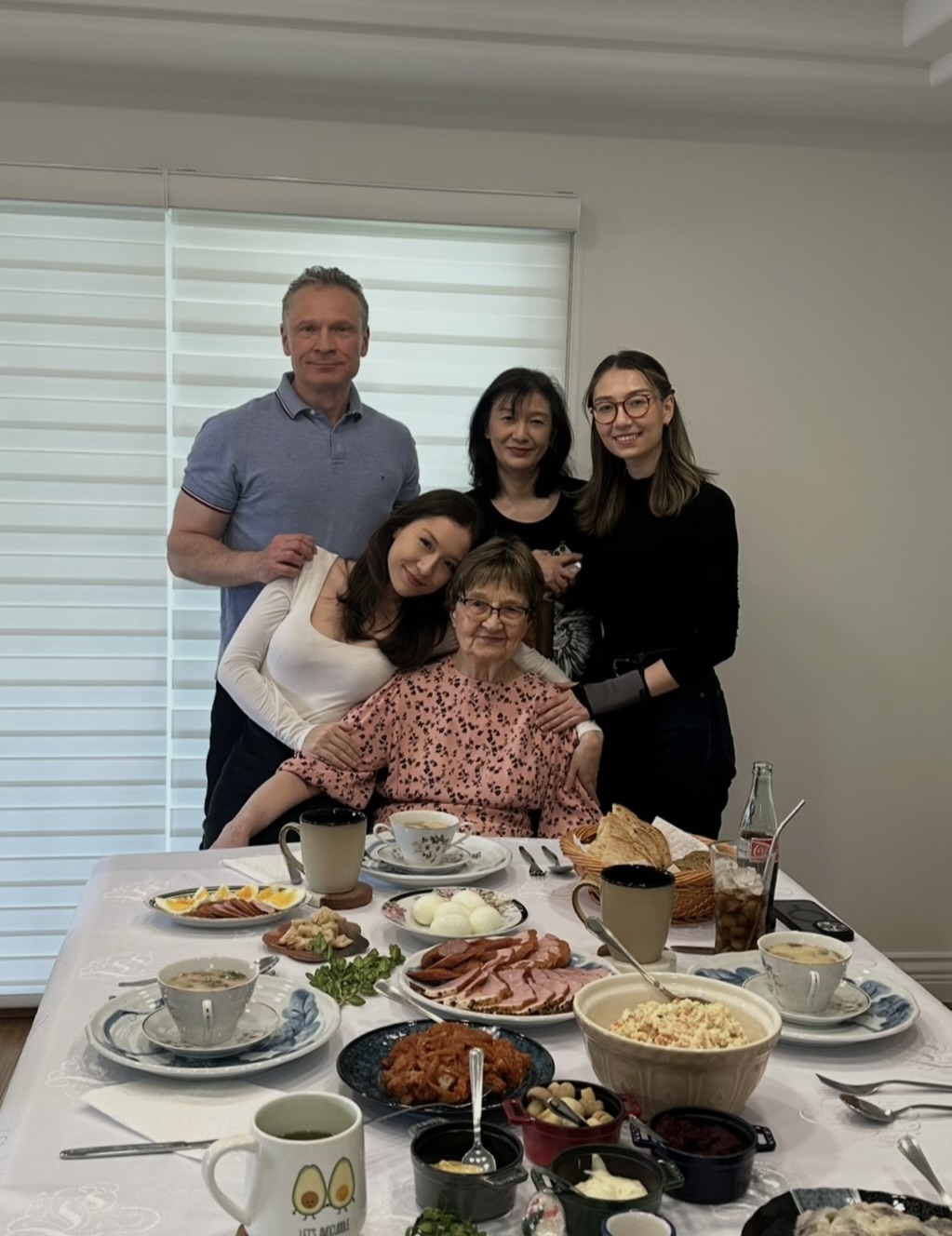
Photo courtesy of Julia Kwasniak.
My interest in immigration law developed as I grew more conscious of mobility rights. Born and raised just outside of Vancouver, I never questioned my right to vote, remain, or build a life here. It was self-evident. Yet, through citizenship by descent, I enjoyed similar rights in Poland and Japan, despite growing up in neither. Those rights felt rather more abstract, and naturally invited exploration.
I certainly had fun with the exploration part. After high school, I spent a few months teaching English in Japan before heading to Poland for my first time. That visit turned into nearly three years of moving back and forth between Poland and Canada. The revelation, so to speak, was that my legal connection to a country had preceded any lived experience of it. My family history had drawn me there, but my citizenship allowed me to stay and develop my own story.
Later, and more importantly, I recognized the asymmetry in access to said mobility rights. For my parents, immigration was a first-order concern: they had to navigate legal barriers to establish their lives in Canada. For me, citizenship was an ascribed status, and mobility largely an inherited entitlement. I found it dissonant how the law could enable some people to move freely, while requiring others to fight to secure similar freedoms. And this contrast existed within a single family, my family. I couldn’t help but wonder: how much greater might those disparities be on a broader scale? Suddenly, access to mobility was far more sensitive, political, unequal, and confusing than I had previously understood.
I should also mention that I was a Psychology major at the time, with a particular interest in the psychology of migration, culture, and identity. So, between my family history, my experiences abroad, and my academic interests, there was quite a melting pot of curiosities that gradually drew me toward immigration law.
These interests eventually led me to pursue a certificate program in immigration policy and procedures alongside my bachelor’s degree at UBC. I qualified as a Regulated Canadian Immigration Consultant in 2022 and joined Harvey Law Group in 2023, where I have since worked as a Case Officer on matters ranging from family reunification and citizenship by descent to economic immigration and judicial review, across Canada, the United States, the Caribbean, Europe, and Asia.
How has your education at Allard/UBC supported you along the way
As a Vancouverite and UBC undergraduate alumna, I must admit I have a certain bias toward UBC. But what I think Allard gets particularly right is its learning environment.
As a student in the digital era, I think there is a certain self-consciousness (perhaps even paranoia) about the footprints we leave behind, particularly the permanence of our expressed opinions and the pressure to always get things right. There can be a reluctance to express an unfinished thought, to risk being wrong, or even to change our minds. Before law school, I worried that the competitiveness often associated with legal education would only amplify that pressure.
Interestingly, despite finding myself in classrooms with some of the brightest, most intelligent people I have met, my experience has been quite the opposite. My professors and peers have made me feel comfortable thinking out loud, having my ideas challenged, and occasionally changing my mind altogether. Put simply, I’ve been grateful for the intellectual freedom I’ve felt at Allard.
What are you doing now in Hong Kong? Tell us about your current exchange and anything you’ve reflected on during your trip.
I am spending this semester on exchange at the University of Hong Kong. Before I arrived, a colleague who has spent years doing business across the Asia-Pacific region described Hong Kong as a place where “if you stand on the street with your hands in the air long enough, you’ll catch money.” After two months here, I can see what he meant.
Hong Kong has a certain financial mojo to it, which I think is part of its charm. The city’s commercial energy is unmatched, and this character extends beyond the financial districts and into the lecture halls.
Although Hong Kong and Canada share a common-law tradition, Hong Kong’s position between Mainland China and global markets creates particular demands on its legal system, especially in cross-border commerce, arbitration, and dispute resolution. With this in mind, I deliberately chose courses such as Arbitration and Conflict of Laws in Greater China to better understand the legal questions particular to the region.
If anything, this exchange has been a great reminder that law does not develop in a vacuum. Geography, history, culture, and commerce all influence the kinds of legal questions that arise and how they are approached.
And, to me, that’s all the more fun.
Reflecting on Canadian immigration/administrative justice generally, where do you see the areas ripe for systems change/improvement.
It would be nice to see clearer processing standards for immigration applications.
This is something I have observed through my work with Start-up Visa (SUV) applicants. Although the program is now paused to new applications, many existing applications remain in the processing queue. I have found the uncertainty surrounding processing times disheartening, to say the least. Some applicants submitted their applications when published processing times were around three years, only to see projections for the program exceed ten years a few years later. While estimates are not guarantees, for entrepreneurs planning their businesses, financing, and permanent relocation, it can feel as though they are dealing with a moving goalpost. It is to the point where applicants may have to consider mandamus to obtain a decision.
Of course, I understand that the Minister needs flexibility in setting processing priorities. But I think applicants should have a reasonable idea of when to expect a decision, and greater transparency about how changes to those timelines affect their applications. Applicants pay fees for the services provided by IRCC, and I think it is fair to expect clearer communication in return.
Thank you, Julia, for taking the time to share your experiences and ideas so openly.
I learned a lot from your answers, and I suspect many readers will too.
The challenges facing migrant communities in Canada are not small, and no one person will solve them. What gives me hope is meeting students like you who are already thinking carefully about how these systems work and who they are meant to serve. If this award makes your path even a little easier, it has done what I hoped it would.
Congratulations, Julia. I wish you all the best for the rest of your exchange and your final year at Allard.
About the Tao Award in Law
Awards totalling $2,000 have been made available annually through a gift from Wei William “Will” Tao (B.A. 2011, J.D., LL.M. 2025) for J.D. students entering third year who demonstrate an interest in serving the legal needs of migrant communities. Preference will be given to students with an interest in immigration or refugee law. Will is an immigration, refugee and citizenship lawyer and the founder of Heron Law Offices. He has served as a supervising immigration lawyer for the Law Students Legal Advice program and as Mentorship Chair for the Federation of Asian Canadian Lawyers. Will returned to UBC in 2023 to complete a Master of Laws degree focused on automated decision-making in Canadian immigration and administrative law. This award honours his father, Jing-Song Tao (1959–2016; Ph.D. 1998) whose immigrant journey from China had a major influence on shaping Will’s life and career. Will hopes this award will inspire future leaders in immigration, refugee and administrative law. The awards are made on the recommendation of the Peter A. Allard School of Law.
Source: Allard School of Law, Awards and Scholarships for Continuing J.D. Students