Heron Law Offices to Participate in Osgoode Hall Law School Human Rights Panel
Artificial intelligence (AI) is increasingly shaping administrative decision-making across Canada, including within immigration and refugee processes. While these technologies offer opportunities for efficiency, they also raise complex legal questions relating to procedural fairness, transparency, and the protection of human rights.
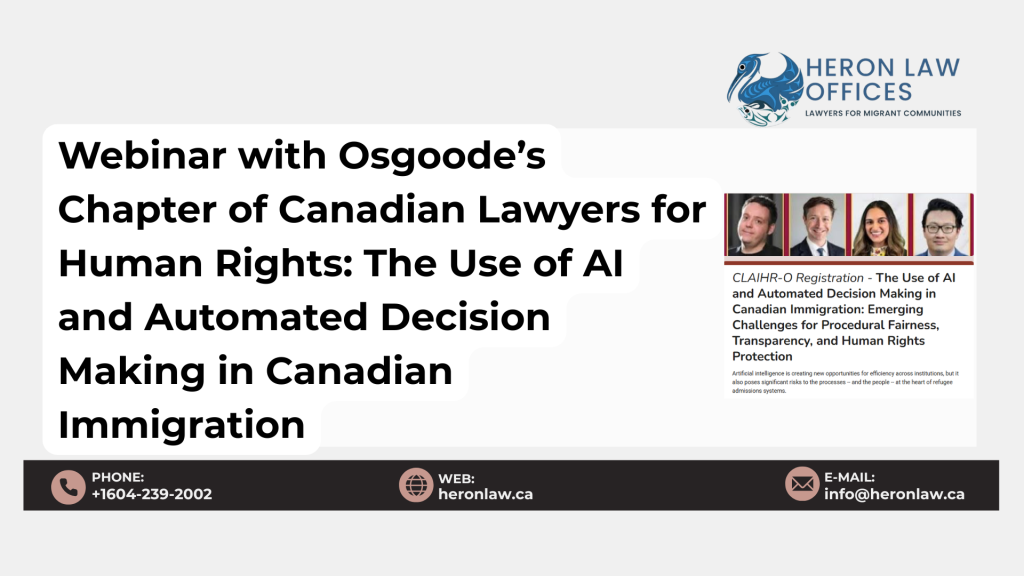
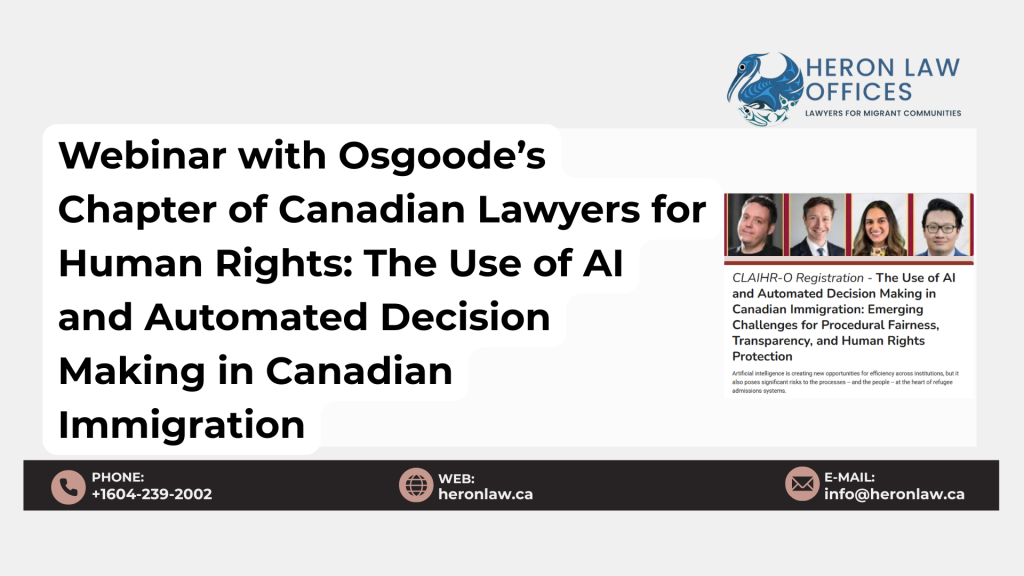
Later today, Heron Law Offices will be participating in a panel hosted by Osgoode Hall Law School’s Canadian Lawyers for Human Rights (CLAIHR), titled “The Use of AI and Automated Decision-Making in Canadian Immigration.”
Our Principal Lawyer, Will Tao, and lawyer Karina Juma will join leading scholars in administrative and refugee law, including Professor Sean Rehaag (Osgoode Hall Law School) and Professor Paul Daly (University of Ottawa), to examine the evolving role of AI in immigration decision-making.
As a law firm engaged in complex immigration matters and judicial review litigation, Heron Law Offices has observed a growing intersection between technology and decision-making processes. Increasingly, AI and automated tools are playing a role in how applications are assessed and outcomes are determined.
This development raises important legal and practical questions, including:
- How procedural fairness is maintained where automated systems are involved;
- The extent to which decision-making processes remain transparent and reviewable;
- Issues of accountability when decisions are influenced by algorithmic systems.
These questions are no longer theoretical. They are emerging in practice and are likely to shape the future of immigration law in Canada.
Heron Law Offices looks forward to contributing to this important discussion and continuing to engage with evolving legal issues at the intersection of immigration, administrative law, and technology.